
NHL Morning Coffee Headlines – July 30, 2026
Reaction to Macklin Celebrini’s record-setting contract extension with the Sharks and its ramifications in today’s NHL Morning Coffee Headlines.
SHARKS SIGN MACKLIN CELEBRINI TO NHL-RECORD CONTRACT.
SAN JOSE HOCKEY NOW: The Sharks signed center Macklin Celebrini to a five-year, $94 million contract extension.
Celebrini, 20, will earn an NHL record average annual value of $18.8 million, breaking the previous record of $18 million signed by Anaheim Ducks center Leo Carlsson earlier this month. The contract begins in 2027-28, and he will be an unrestricted free agent upon its completion in 2031-32.
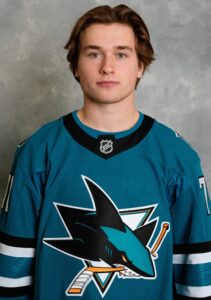
San Jose Sharks center Macklin Celebrini (NHL Images).
PuckPedia indicates that Celebrini will earn a base salary of $950,000 with a $19.85 million signing bonus for 2027-28 and 2028-29. He’ll earn a $1 million base salary with a $19.8 million signing bonus in 2029-30, $1 million with a $16.1 million signing bonus in 2030-31, and $1 million with a $13.5 million signing bonus and a full no-movement clause in 2031-32.
SPECTOR’S NOTE: Celebrini has only played two NHL seasons, but he earned that whopping pay raise after finishing fourth among NHL scorers last season with a franchise-best 115 points. He is truly a generational talent who established himself among the NHL’s superstars last season, and the undisputed foundation player for the rebuilding Sharks.
Celebrini is another high-salaried player earning the bulk of his money in annual signing bonuses. It’ll be interesting to see if the league allows that practice to continue in the next CBA once the current one expires in September 2030.
Signing bonuses aren’t a salary-cap loophole because the total value of the bonus counts against the average annual value. What it does is guarantee players more money upfront, even if there’s a lockout or an unforeseen event (like a pandemic) that could shorten or shut down a season.
What could make signing bonuses a contentious issue is that wealthy teams can afford them more easily than small-market or cap-strapped teams. That could give deep-pocketed clubs an edge in re-signing talent, especially those eligible for unrestricted free-agent status.
It also creates the situation we saw with Anaheim Ducks center Leo Carlsson. Earlier this month, he signed an expensive offer sheet with the Philadelphia Flyers, who gambled that the Ducks couldn’t afford to match it because of the hefty signing bonuses. The Ducks matched, but it created an expensive headache for them later.
Speaking of Carlsson’s offer sheet…
NBC SPORTS PHILADELPHIA: Jordan Hall believes that Flyers GM Daniel Briere’s bold signing of Leo Carlsson to a five-year, $90 million offer sheet led to Celebrini’s expensive new contract with the Sharks.
Briere’s offer sheet to Carlsson, which the Ducks matched, set the market for young talent such as Celebrini, and for Connor Bedard, who inked a five-year, $75 million contract ($15 million) with the Chicago Blackhawks on July 18.
With the salary cap rising to $113.5 million in 2027-28, and projected to reach $123 million in 2028-29, contracts for the league’s top stars will become more expensive.
SPECTOR’S NOTE: The ripples from the Flyers’ bid to land Carlsson will be felt for years. It couldn’t have happened without the substantial increases in the salary cap.
It could also create a situation in which the NHL once again finds itself with “have” and “have-not” franchises, something the salary cap was supposed to address over 20 years ago. Teams in smaller markets could find it difficult simply to reach the annual salary cap minimum, losing players through free agency or cost-cutting trades to wealthier markets flush with cap space.
The NHL has a better revenue-sharing system in place to help small-market or struggling franchises than it did over 20 years ago. Nevertheless, it might not be enough to help some of them remain competitive against richer, well-managed teams.
TSN: It remains to be seen how Celebrini’s new deal affects the Columbus Blue Jackets’ efforts to re-sign Adam Fantilli and the Ducks’ efforts to re-sign Cutter Gauthier. Both are currently restricted free agents.
Meanwhile, the Celebrini and Carlsson contracts will also affect how much veteran superstars such as Connor McDavid of the Edmonton Oilers, Cale Makar of the Colorado Avalanche, and Nikita Kucherov of the Tampa Bay Lightning. McDavid is eligible to become an unrestricted free agent in 2028, while Makar and Kucherov are UFA-eligible next July.
Dallas Stars winger Jason Robertson and Minnesota Wild defenseman Quinn Hughes will also be in line for substantial raises. Like Makar and Kucherov, they are slated to become UFAs next summer.
SPECTOR’S NOTE: One of those veterans will become the NHL’s first $20 million man. McDavid and Makar seem the most likely candidates. We can also add Auston Matthews of the Toronto Maple Leafs, who is slated to join McDavid in the 2028 UFA class.
NBC SPORTS BAY AREA: Sheng Peng reports Sharks general manager Mike Grier said he didn’t think team owner Hasso Plattner would’ve hesitated to pay Celebrini the league maximum of $20.8 million annually if that’s what he wanted. He commended the young center for accepting less than market value as one of the best players in the league.
Peng believes Grier is now on the clock to build a playoff team around Celebrini, and eventually, a true Stanley Cup contender.
SAN JOSE HOCKEY NOW: With Celebrini re-signed, GM Mike Grier is shifting his focus to re-signing some other young Sharks.
Grier indicated that negotiations continue with Collin Graf’s camp, adding that the two sides are getting closer to a new contract. It’s projected the restricted free-agent forward could receive a two-year, $7.8 million deal or $45.5 million on a seven-year contract.
Like Celebrini, Will Smith can sign an extension this summer. Grier indicated that he’d like to get the 21-year-old forward under a long-term contract as soon as possible. It’s projected that Smith could get a five-year, $50 million deal ($10 million AAV).
NHL.COM: Sharks sophomore forward Michael Misa believes his rebuilding young team will take another step forward this season. The young club was in contention for a playoff berth throughout last season, finishing four points shy of a Western Conference wild-card berth.
Misa is excited to see what Celebrini will do for an encore this season after his 115-point sophomore campaign. The Sharks added veteran defensemen Darnell Nurse and Jacob Trouba, winger Mason Marchment, and goaltender Eric Comrie. They also signed top prospect Ivar Stenberg after selecting him with the No. 2 pick in this year’s draft.
SPECTOR’S NOTE: The Sharks had little choice but to sign Celebrini to his expensive new contract. It will also cost a lot to re-sign Smith, something Grier understandably wants to do now before his value climbs again. Misa could also be another high-priced re-signing next summer if he blossoms as expected in his sophomore campaign.
Misa is justified in his excitement about his promising team’s future. However, building the Sharks into a contender got more expensive.
PuckPedia indicates that the Sharks currently have $34.7 million cap space for 2027-28, the first season under Celebrini’s new contract. Assuming Smith gets $10 million annually and Graf $6.5 million on long-term deals, they’ll have around $18.2 million left. That will give them more than enough to re-sign promising goalie Yaroslav Askarov, who is an RFA with arbitration rights next summer, and sufficient space to fill out the remainder of the roster.
However, it could become more costly over the following two years. That’s when Misa, Sam Dickinson, Igor Chernyshov, and Stenberg will be due for new contracts. They’ll also face finding suitable replacements for aging core players Tyler Toffoli and Dmitry Orlov, and for backup goalies Alex Nedeljkovic and Eric Comrie.
The rising cap should help Grier in his efforts to re-sign or replace those players. However, the cost of doing so could reach a point where they run out of sufficient salary-cap space to add the necessary depth to become a Stanley Cup contender.
I don’t know how much Carlsson’s offer sheet impacted Celebrini or Bedard.
We expected bedard to come in in the 14 to 15 range before the offer sheet and that is where it got done.
No one should be shocked by Celebrini’s contract. He left an even 2m on the table. Does anyone believe he would have left 3, 4 or 5 mil if the offer sheet did not to Leo happen. I don’t that even 2 mil seems like it may have always been the idea. If it was about making more than Leo it would be more sensible to be 18.5…but like everyone else…just speculation on my end.
Now i certainly believe the structure had influence with the bonus paydays for sure and that needs to be reviewed, especially on offer sheets but I dont know all the particulars. The team making rhe offer sheet has weeks and even months to plan and free up 20 mil in funds as opposed to 7 days to match seems like an unfair advantage.
Now yes Leo’s contract is impacting the league for others as they comp to him…like Cutter for instance…but i dont know how much it impacted bedard, celebrini this summer is all I am saying.
Early projections for Bedard before the Carlsson contract was in the $12-$13 million range. Celebrini was also around $13-$15 million BC (Before Carlsson).
Really. I apologize for not paying sharp attention and I digress hindsight makes theirs clearer but why would these estimations ignore comparing either to kirill,’s contract.
Bedard a bit under…celebrini a bit above and highest paid…makes sense.
I dont agree, I think it made them 2-4 million higher. I think they all are making a mistake, even Carlsson, if they want to win, I dont care how much the cap rises, you need to have 4-5 guys making 4-8 million in the middle of the lineup. With this rising top level guys making so much, there wont be enough left for secondary scoring
The Carlsson, Celebrini and Bedard contracts, in consuming upwards of around 16% of a rising salary cap when they kick in will, in effect, actually shrink in that regard when compared to some notable deals of past seasons.
So, paying elite franchise marquee players, in and of itself, is not where real financial pressure very likely will arise. Rather, as history has amply demonstrated, that ensues with the inability to retain the better of a team’s bottom 6 Fs, bottom-pairing D and back-up goaltenders – the “glue” guys – when they reach RFA/UFA status, amply described as “the middle class squeeze” in some sources.
At some point, Anaheim, San Jose and Chicago will be hit between the eyes by the simple fact that paying a premium for depth becomes a luxury they cannot afford, and so be forced to let their highest-value role players move on to avoid cap strangulation, and so have to settle for lesser-lights at minimal costs. Toronto and Edmonton can attest to that.
Both Toronto and Edmonton (as all other teams) had to contend with a global crisis for a couple of seasons that hampered projections and ultimately made both teams unsuccessful in filling their line up with viable players.
Dollar figures are useless but using cap percentages as a metric is more telling than a big dollar figures because saying 15% or 20% of a $110M cap just isn’t as sexy as saying $18m/season, which is a crazy dollar figure.
I’m glad it ain’t my money.
On another note, it’s nice hearing from you G.
You are correct, George, but there are a couple of ways this could go. A lot depends, I think, on expansion. As we look at the number of good, well-coached young players, and the fact that an AHL salary is now a good living one can raise a family on, which may allow more players to stay in the game as they mature and get seasoning, we may have a situation where below the median there are more “NHL Quality” players than slots. There might be a lot of competition for these 1.5 MM slots in a distinctly two tier league. If there is expansion, or a real uptick in the economics of European play, then the have-nots may have trouble filling out their roster bottoms, and it will be a three tier league with a flux of entry level contracts and lowest end one year deals at the bottom. Reminder, par of the reason we have the cap is the fans in non-competitive markets wouldn’t pay to watch bad hockey year after year. Bettman’s strongest legacy may be that he convinced all the parties to strengthen the league as a whole.
George, it won’t just be the depth players (which do somehow get overlooked value against), it’s every other position because now every other position will cost more, top to bottom.
Here is how I see it:
No team has two fully loaded top lines. Improvement now costs more.
To wit: the Habs search for a 2C. What might have cost 6 or so million for a good 2C is now more. So much for the 9 million the Habs have in cap space.
And to your point the ripple effect goes down the line up.
Next, acquiring a player with a favourable contract through trade now costs more as any such favourable contract has in itself become more valuable. So the payment will increase in picks, prospects or other players.
This new cost amplifies the advantage non tax states have (sorry Lyle, but that now is indeed a clear advantage), and while a Cup contender will also have an advantage that contender is almost assuredly going to be (as Lyle predicts) a “have” team with an advantage in money to spend against the cap.
Good time to point out that within the last year, the Habs have signed Lane Hutson, already one of the leagues top D-men, and Ivan Demidov, a budding young superstar, to contracts that will run far past Celebrini’s deal at a combined cap hit of less than Celebrini’s. While an argument can certainly be made that Celebrini is a better and more valuable player than either Hutson or Demidov, he’s certainly nowhere close to the value of the two of them combined. Those signings looked great when they were done. They look even better now and will likely continue to look even better.
And it will allow Montreal to win, SJ might as well but they will have a much shorter window to do so
Signing players to good contracts is no indication of success. It happens more often than not, actually. Just like you can’t judge a team after one game or one season.
It’s definitely helpful to have good players sign accordingly but will it be enough? I don’t think so but definitely doesn’t hurt unless you end up with a good but not quite championship team.
The Habs window, based solely on today’s contracts, is about 5 years, Kent. And while I think Celebrini will soon be the best forward in the game, his current supporting cast has yet to prove their worth.
Lyle, BC before Carlsson very nicely done sir. Maybe players that accept considerably less than market value to help build a Cup contender can be referred to as AD after Demidov.
Touche! Nicely done, Snold49.
haha, I like it… even though it seems to place more blame on Carlsson than on Briere… 🙂
Regarding the signing bonus limits, starting with the upcoming CBA in Sept, they are changing it so contracts can’t have more than 60% of the total deal in signing bonuses.
I wish they put these changes (along with the reduced total years of contracts) into place immediately following the season.
I have no idea they pushed the new rules instead of having them come into effect July 1 when the 2016-17 season officially starts.
I do not have an issue in paying a TRUE star top dollar. But cap management takes strategy up and down your lineup, and that is where paying AJ Greer $4.25m or Trouba $8.25m is reckless and feeds into long term management issues. I also think teams are too quick to pay top dollar for players that show potential but yet to achieve star status. Celebrini is a true star so he should get top dollar, Smith at $10m not sure if he is worth that at this point, Graf at $7m, again not sure if that is wise either. That’s where managers need to be thrifty in evaluation middling talent, or “potential”.