Blackhawks “Dynasty” Forever Tarnished

Blackhawks “Dynasty” Forever Tarnished

On June 10, 2010, one of the longest Stanley Cup droughts in NHL history came to an end. An overtime goal by Patrick Kane against the Philadelphia Flyers in Game 6 of the Stanley Cup Final gave the Chicago Blackhawks their first championship since 1961.

It was the start of several dominant years for the Blackhawks. Over the following five seasons, the Blackhawks would win two more Stanley Cups. Kane, team captain Jonathan Toews and defenseman Duncan Keith established themselves as respected NHL superstars. Head coach Joel Quenneville burnished his resume as one of the league’s top bench bosses. General manager Stan Bowman was praised for his ability to maintain his championship roster.

Stanley Cup dynasties – teams that win three-or-more consecutive Stanley Cups – are rarities in the NHL’s salary-cap world. As a result, some observers considered the Blackhawks’ three championships in six years the closest thing to a Cup dynasty in today’s game.

Eleven years after that first Cup, that “dynasty” is forever tarnished by a scandal set in motion three weeks before Kane’s winning goal.

A small group of senior team executives, including Bowman and Quenneville, reached the fateful decision to cover up allegations of sexual assault made by winger Kyle Beach against video coach Bradley Aldrich.

They decided not to take any action against Aldrich until after the Stanley Cup Final so as not to risk the matter becoming a distraction for the players. After their celebrations with the Cup in Chicago had quieted down, the club gave Aldrich a choice of stepping down or facing an internal investigation.

That reference helped Aldrich get a job with USA Hockey and an assistant coaching job with a high school in Houghton, Michigan. Three years later, Aldrich was sentenced to nine months in jail on a fourth-degree criminal sexual conduct charge for his alleged involvement with a male student between the age of 16 and 18. The student filed a lawsuit against the Blackhawks earlier this year for providing a positive employment letter to Aldrich even though they knew he was a sexual predator.

Thanks to the courage of Beach and the student known as “John Doe 2” in stepping forward to tell their stories, aided by the dogged investigative journalism of TSN’s Rick Westhead and The Athletic’s Katie Strang, the Blackhawks were forced to conduct an independent investigation.

The resulting report, released to the public last week, was damning.

Bowman stepped down as general manager while another club official was relieved of his duties. Quenneville, who’d moved on to coach the Florida Panthers, resigned from that job following a meeting with NHL commissioner Gary Bettman.

None of the players on the 2010 Blackhawks roster were mentioned in the report. Kane, Toews, Keith (now with the Edmonton Oilers) and others denied knowledge of the allegations. Beach, in his emotional interview with Westhead a day after the report was released, believed everyone in the dressing room knew. His story was supported by the testimony of former teammates Nick Boynton and Brent Sopel when they spoke with investigators this summer.

Only two players (Boynton and Sopel) along with former associate coach John Torchetti and former skills coach Paul Vincent, supported Beach and testified to investigators on his behalf. Nearly everyone else on that 2009-10 roster is facing scrutiny from fans and the media over what they did or didn’t do at the time the allegations were raised.

Winnipeg Jets general manager Kevin Cheveldayoff was the Blackhawks assistant GM at the time and took part in that fateful meeting before the 2010 Cup Final. Though he was cleared of any wrongdoing in a subsequent meeting with Bettman, he still faces calls for an apology to Beach from fans and pundits and a further explanation of his actions while with the Blackhawks.

Despite their denials, the reputations of the Blackhawks stars have suffered a significant blow. Assuming they had no knowledge of the incident at the time, they’re facing questions over when they did find out, how much they knew and why they didn’t do more to try and help Beach. The tone-deaf defense of Bowman by Kane and Toews following his dismissal was not a good look for either star.

The fallout isn’t just limited to the Blackhawks. NHLPA director Donald Fehr is feeling the heat from the player executive and rank-and-file members for his apparent inaction when Beach and his agent informed the PA of the allegations.

For Blackhawks fans, this is a devastating gut punch. The club they love and support, an Original Six franchise considered the epitome of a successful franchise in the salary-cap era, has been brought low by a handful of men who did nothing to protect a frightened young player from a sexual predator. It could take years for the Blackhawks to rebuild their standing and regain the full trust of their fans and win back those they lost from this sordid scandal

Bowman and Quenneville will probably never work in the NHL again. Kane, Toews, Keith and other players had nothing to do with how their club handled the allegations but they’ll face lingering doubts in the court of public opinion.

All of that pales in comparison to the hell Kyle Beach went through for 11 years. He was ostracized by the Blackhawks, even reportedly mocked by several teammates. He continued his playing career away from the NHL. Somehow, he found the determination to carry on every day despite his terrible burden and the courage to fight back with limited support despite the Blackhawks’ efforts to discredit him.

As more than one observer noted, Beach show more bravery and integrity than those who failed him.

Six men made a fateful decision that did immeasurable harm to Beach and another young man. That decision would eventually damage their own reputations and careers, in some cases beyond repair. It cost them their jobs, tarnished a once-great franchise, cast a dark cloud over the lives and careers of their franchise players, and stained the league’s brand.

All because they put winning a championship over doing the right thing.

That’s the dark legacy of the Blackhawks “dynasty.”


Kotkaniemi Offer Sheet Highlights Canadiens Poor Draft Record

Kotkaniemi Offer Sheet Highlights Canadiens Poor Draft Record

The Carolina Hurricanes signing away Jesperi Kotkaniemi from the Montreal Canadiens provided a week of welcome excitement for NHL fans bored by the off-season dog days. It’s the first successful offer-sheet signing since the Edmonton Oilers landed Dustin Penner from the Anaheim Ducks in 2007.

NHL pundits and fans of both clubs will watch with interest over the next several years to determine which club made the right decision.

Former Montreal Canadiens center Jesperi Kotkaniemi (NHL Images).

This could blow up in the Hurricanes’ face or prove a shrewd move to take advantage of a cap-strapped rival. It also provides them with a measure of revenge for the Habs failed attempt to sign Sebastian Aho to an offer sheet two years ago.

The Canadiens, meanwhile, could face the humiliation of seeing a promising if inconsistent young player blossoming into a star in Carolina. Then again, they could breathe a sigh of relief if Kotkaniemi fails to develop as hoped.

L’Affaire Kotkaniemi also served as a significant reminder of what a lousy job the Canadiens have done drafting and developing talent.

I wrote about this back in January 2020, reviewing what at that point was 27 years of Canadiens fans futilely waiting for each crop of promising talent to blossom into stars that would carry their club back to Stanley Cup glory.

They came oh-so-close earlier this year. Thanks in part to homegrown stars such as Carey Price and Brendan Gallagher and youngsters such as Kotkaniemi, Nick Suzuki, Cole Caufield and Alexander Romanov, the underdog Canadiens shook off a difficult regular season to reach the Stanley Cup Final.

Nevertheless, the Canadiens have a long history of busts among their first-round picks since their last Stanley Cup championship in 1993. As I wrote in 2020:

“From Terry Ryan, Matt Higgins, Eric Chouinard and Alexander Burturlin in the 1990s, through Marcel Hossa, Alexander Perezhogin, David Fischer and Louis LeBlanc in the first decade of this century, to Jarred Tinordi, Michael McCarron and Nikita Scherbak in the last decade, all were once touted as potential foundation pieces for future championship clubs in Montreal. None made much of a mark in their short careers.”

Tinordi, McCarron and Scherbak were selected by current Canadiens general manager Marc Bergevin and his scouting staff. Since becoming GM in 2012, the Habs’ first-round picks also included Alex Galchenyuk (2012), Noah Juulsen (2015), Mikhail Sergachev (2016), Ryan Poehling (2017), Kotkaniemi (2018), Caufield (2019), Kaiden Guhle (2020) and this year’s unfortunate choice of Logan Mailloux.

Galchenyuk showed promise as a scorer but eventually played his way out of Montreal and has bounced among several NHL clubs. Juulsen’s career was nearly ended by an eye injury before being claimed off waivers by the Florida Panthers earlier this year. Swapped for Jonathan Drouin in 2018, Sergachev blossomed into a star with the Tampa Bay Lightning. Poehling has yet to crack the Habs roster on a full-time basis while Kotkaniemi’s struggles were well-documented during his three years in Montreal.

Caufield made the jump from college hockey last season, becoming a key ingredient in the Canadiens run to the 2021 Cup Final. Guhle is a big, promising defenseman who appeared in three games with the Habs’ AHL affiliate in Laval last season. Mailloux, meanwhile, is suspended indefinitely from the OHL this season after being fined last year by Swedish police for sharing a photo among his teammates of an 18-year-old woman engaged in a consensual sexual act with him without her permission.

Bergevin’s predecessors didn’t have a stellar record of first-round selections but they could at times strike gold in the first round (Price, Ryan McDonagh, Max Pacioretty) or subsequent rounds (Jose Theodore, Andrei Markov, P.K. Subban, Gallagher). Of his selections, only Sergachev has truly panned out but that was after he was traded to the Lightning. Caufield has the makings of a star but it’s too early to determine what he’ll truly become based on his short NHL career to date. 

It’s too early to tell how things will work out for his selections over the past three years. It takes time for promising youngsters to reach their full potential, with some taking longer than others. Still, there’s no denying the Canadiens haven’t been getting much bang for their buck from their prospect pipeline.

Some of that could be down to poor scouting. Some of it could also be because the Canadiens are doing a poor job preparing those young players for NHL duty.

Bergevin’s saving grace is his ability to win more trades than he loses. Suzuki, Shea Weber, Jeff Petry, Phillip Danault, Josh Anderson, Jake Allen, Joel Edmundson and Joel Armia were among the notable acquisitions on the roster during their deep postseason run last season.

Nevertheless, Kotkaniemi’s struggles with the Canadiens cast a harsher spotlight on how the Habs draft and develop talent. If he goes on to improve and his full potential in Carolina it will only stoke criticism of Bergevin and his staff. It could eventually lead to changes in the front office, starting with the general manager.


Is There a “Right Way” To Retire NHL Jersey Numbers?

Is There a “Right Way” To Retire NHL Jersey Numbers?

The New York Rangers’ plan to retire Henrik Lundqvist’s number prompted the Pittsburgh Tribune-Review’s Mark Madden to suggest some teams conduct that practice too frequently.

While taking note of Lundqvist’s 15 seasons with the Rangers, Madden pointed out he never won a Stanley Cup, appeared in just one Cup final and won the Vezina only once. He suggested no one would know who Lundqvist was if he played in Buffalo but he gets his number retired because he played for the big-market Rangers.

Madden also pointed out the Rangers, who’ve won just one championship since 1940, retired eight numbers honoring 10 players but only three won the Stanley Cup. He felt that “when glory isn’t earned, it’s good PR to bestow it.”

That’s a blithe dismissal of Lundqvist’s accomplishments and of his fellow Ranger greats who lack a Stanley Cup on their resumes.

Lundqvist had a career worthy of the Hockey Hall of Fame and could become a first-ballot inductee. He was the Rangers’ franchise player throughout most of his NHL career. He’s their all-time leader in games played for goalies (887), save percentage (.918), shutouts (64) and wins (459), ranking sixth all-time in that category among NHL goalies.

Henrik Lundqvist’s jersey number (30) will join those of other Rangers greats (NHL.com).

Rod Gilbert, who recently passed away at age 80, is another Ranger great who never won the Stanley Cup. He was their first player to have his number retired following 18 seasons from 1960-61 to 1977-78. He still holds the franchise record with 406 career goals and 1,021 points and was inducted into the Hall of Fame in 1982.

Jean Ratelle played over 14 seasons with the Rangers, most of those as Gilbert’s linemate. He’s second among their all-time scoring leaders with 336 goals and third with 481 assists and 817 points. He won the Pearson Award (now the Ted Lindsey Award) in 1971-72, the Masterton Trophy in 1971 and the first of his four Lady Byng Memorial Trophies as a Ranger. He went into the Hall of Fame in 1985.

Harry Howell was a Ranger for 17 of his 21 NHL seasons, holding the club record with 1,160 games. He was the last player to win the Norris Trophy as the top defenseman before the league expanded from six to 12 teams in 1967. Howell was inducted into the Hockey Hall of Fame in 1979.

Madden also took swipes at teams with “legit history” like the Montreal Canadiens and Toronto Maple Leafs who “don’t necessarily get it right” when retiring numbers.

The Canadiens have retired 15 numbers honoring 18 players. Madden acknowledged it’s hard to argue against their choices but felt that’s a bad thing and “stupid” because it leaves too many of their current players skating with numbers in the 40s through the 90s, making them look like a roller-hockey team.

So what are the Canadiens supposed to do? Not honor the plethora of great players who played leading roles in their rich history, including their league-leading 24 Stanley Cup titles? It’s also worth noting the Canadiens aren’t the only team with current players sporting high jersey numbers and they certainly don’t look embarrassing doing so. Some even include such Hall-of-Famers as Wayne Gretzky (99), Eric Lindros (88) and Mario Lemieux (66).

Turning to the Leafs, Madden observed five of their 19 players to have their numbers retired (Mats Sundin, Darryl Sittler, Borje Salming, Doug Gilmour and Wendel Clark) played during their Cup-less years since 1967.

As with Lundqvist, Gilbert, Ratelle and Howell with the Rangers, Sundin, Sittler, Salming and Gilmour are among the Leafs’ all-time greats and Hall-of-Fame inductees. The lack of a Stanley Cup on their resumes as Leafs (Gilmour won his with the Calgary Flames) shouldn’t be held against them having their jersey numbers retired.

I do agree with Madden over the retirement of Clark’s number despite being one of my favorite Leafs. He was often the only good thing during the dark ages of the Harold Ballard era and a long-time fan favorite. Retirement of his number seemed mostly for sentimental reasons but that’s the Leafs’ prerogative and their fans don’t have an issue with it.

Madden believes the Pittsburgh Penguins “do it right” when retiring numbers. Only Mario Lemieux and Michel Briere received that honor from the Penguins. Sidney Crosby, Jaromir Jagr and Evgeni Malkin are certain to enjoy the same accolade once their Hall of Fame-worthy playing careers have ended

By the way, Lemieux, Crosby and Jagr all wore numbers in the 40 through 90 range without making their team look like a roller-hockey team.

The argument can be made the Penguins only have a tiny fraction of retired or soon-to-be-retired numbers because they represent two bright periods (1990 to 1997, 2008 to 2016) in the Penguins’ 55-year history. Many of the years leading up to the Lemieux-Jagr era were mostly mediocre. Lemieux’s final seasons were spent with a floundering club on the brink of relocation before a new arena save them during the Crosby-Malkin era.

Using Madden’s logic, we can make the case against the retirement of Briere’s number. That honored was bestowed when the young forward was killed in a car accident in 1970. It was a tragic end to a promising NHL career, but was it really worth retiring his number?

There’s really no “right way” to honor former or fallen players. Those who enjoyed Hall of Fame careers deserve that accolade regardless of whether they won the Stanley Cup. There’s also nothing wrong with retiring the number of a long-time fan favorite or remembering a player full of promise whose career was sadly cut short.

Now, if you want to critique teams that raise banners for meaningless regular-season accomplishments, that’s a bone worth picking.


Is The Coyotes’ Saga in Arizona Drawing To A Close?

Is The Coyotes’ Saga in Arizona Drawing To A Close?

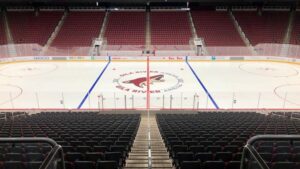
The city of Glendale’s decision to opt-out of its lease agreement for Gila River Arena with the Arizona Coyotes prompted speculation about the club’s future among fans and pundits.

Some observers, including NHL commissioner Gary Bettman, think this is merely a bluff by the city of Glendale to secure a better lease agreement from the Coyotes. That doesn’t appear to be the case. After years of late or delinquent payments, the city council seems to have had enough.

Coyotes owner Alex Meruelo has explored constructing a new arena closer to downtown Phoenix for the past couple of years. There’s no indication the club is close to securing a viable location.

Barring a last-minute change of heart by Glendale’s city council, the Coyotes will be scrambling to find a new home for the 2022-23 season. Even if Meruelo finds a suitable spot for a new arena, it would take two or three seasons before it would be ready.

This is just the latest chapter in the long, sad saga of the Coyotes’ story since its original incarnation as the original Winnipeg Jets moved to Phoenix in 1996. A quarter-century of roster mismanagement, the move to Glendale, multiple owners, poor attendance and a culture of losing have turned this franchise into a league-wide laughingstock.

Despite the Coyotes’ woes, however, hockey is actually thriving in Arizona.

The Coyotes’ small but loyal fan base has stuck with the club through thick and mostly thin. The club has also played an ongoing role in sponsoring and developing youth hockey in the state.

A 2019 USA Hockey report revealed Arizona ranked second among all US NHL markets in total growth percentage of the sport over the previous five years. The state ranked first that year among those markets in girls eight and younger growth percentage, and girls 19 and younger youth growth percentage. It was also ranked third in total growth percentage in one year.

Arizona is also producing NHL talent, with Toronto Maple Leafs superstar Auston Matthews the state’s most well-recognized player. In 2020, ESPN.com reported Matthews was having a positive effect on youth hockey in the state. He’s inspiring a young generation of Arizona players.

Meanwhile, several former NHL players who have retired around Phoenix have taken up coaching youth hockey in the area. The only drawback to hockey’s rapid growth in the state is the lack of suitable ice facilities to accommodate the growing number of players.

Nevertheless, the Coyotes critics will point to the club’s soap-opera existence and years of low attendance as justification to relocate the team. Some suggest moving to Houston, Texas, where Tilman Fertitta, owner of the NBA’s Houston Rockets, could still be keen to own an NHL franchise. Others propose a former NHL market such as Quebec City, or to a city such as Kansas City with an NHL-size arena.

Rest assured the NHL, led by commissioner Bettman, will pull out the stops to keep the Coyotes in Arizona just as it has since former owner Jerry Moyes put the team into bankruptcy in 2009.

Moyes hoped to sell the club to Canadian billionaire Jim Balsillie, who wanted to relocate the franchise to Hamilton, Ontario. The league went to court to prevent it from happening. It has since done all it can since to keep the club in Arizona.

The main reason, of course, is the market size. The metropolitan area of Phoenix is the 10th largest in the United States with over 4.9 million people as of 2019, one the NHL doesn’t want to abandon.

Houston’s market is over 2 million larger but the NHL already has a franchise in Texas. While the state of Texas is big enough to support two NHL teams, the Dallas Stars might not be keen to have a rival on its patch potentially siphoning away fans and dollars.

While the Coyotes will have the league’s full support, the franchise could now be in more real danger of moving than at any time in its history. If Meruelo fails to find a suitable temporary local venue while a new arena is built (assuming one will be constructed), the Coyotes will be forced to play out of state while they await their new home.

Bettman indicated Meruelo remains committed to a new arena, but that could be easier said than done. An in-depth report earlier this year by The Athletic’s Katie Strang revealed financial woes were among several issues plaguing the club.

Construction of a new arena won’t be funded solely by the Coyotes. Meruelo will likely seek the financial support of local and state governments. Those discussions probably haven’t even started yet and could founder if public officials decline to pick up a hefty chunk of the tab.

The NHL carried the Coyotes for years but it can’t keep them in Arizona without a suitable arena. If that’s not coming within the next two or three years, the club’s much-anticipated relocation could become a reality.


Little Notable Talent Still Available in 2021 NHL Free Agent Market

Little Notable Talent Still Available in 2021 NHL Free Agent Market

Cap Friendly shows slim pickings for talent three weeks after the NHL annual free-agent market opened on July 28. As usual, most of the top players were quickly signed within hours of the market opening, with the remainder snapped up over the next several days.

Several recognizable names remain but almost all are now past their playing prime. With training camps set to open in a little over a month, those still available could end up accepting cheap one-year deals or professional tryout offers in hope of landing a contract.

Still, for teams seeking experienced depth at bargain-bin prices, several noteworthy options remain obtainable.

Tuukka Rask is among several notable players still available in the 2021 NHL free-agent market (NHL Images).

Goaltenders

Tuukka Rask is sidelined until the New Year recovering from off-season hip surgery. It’s believed he’s only interested in returning with the Boston Bruins, who could keep a spot open for him. The former Vezina Trophy winner could be worth pursuing later this season if he and the Bruins part ways before the trade deadline.

Devan Dubnyk is still waiting for a contract. The 35-year-old struggled as a backup last season with the San Jose Sharks and Colorado Avalanche. Still, he could be worth the gamble on a PTO for teams with a young starter seeking an experienced mentor.

Henrik Lundqvist hinted he’d be up to a comeback if he receives medical clearance. Heart surgery sidelined him for all of last season. The 39-year-old “King Henrik” is no longer an elite netminder but could be a worthwhile backup if he gets a clean bill of health.

Defensemen

Zdeno Chara had a good performance last season as a third-pairing defensemen with the Washington Capitals. The 44-year-old future Hall-of-Famer is training in Slovakia and hasn’t made any decisions about this season. He’d bring plenty of experience and leadership to any blueline if he decides to return for one more year.

Jason Demers could be a worthwhile addition for teams seeking an experienced third-pairing right-shot defender. The same goes for Sami Vatanen though his long injury history hurts his value.

Erik Gustafsson’s puck-moving abilities could be useful for teams looking for a power-play specialist on the blue line. Erik Gudbranson’s toughness and leadership keep earning him work despite the decline in his defensive game.

Forwards

Zach Parise, Kyle Palmieri, Travis Zajac and Casey Cizikas are still available but speculation suggests they’ve already been signed by the New York Islanders. It’s believed Isles general manager Lou Lamoriello doesn’t want his rivals to know how much cap space he’s actually got left as rumors persist he’s shopping for a top-six forward.

Assuming those four are off the market, well-known but fading forwards such as Patrick Marleau, Eric Staal, Bobby Ryan and James Neal are available. Other noteworthy forwards among the 30-plus gang include Tyler Bozak, Artem Anisimov, Tyler Ennis, and Alex Chiasson.

Alex Galchenyuk heads the list of younger options in the mid-to-late twenties. There was talk the Toronto Maple Leafs could bring the 27-year-old forward back but it appears he’ll be seeking work elsewhere. Ryan Donato, Dominik Kahun, Riley Sheahan and Jimmy Vesey round out this group.


Reviewing Some Recent Notable NHL Trades & Free-Agent Signings

Reviewing Some Recent Notable NHL Trades & Free-Agent Signings

July 25 to 31 was a busy week in the NHL following the entry-draft weekend with the annual free-agent market opening on July 28.

I noted the top UFA signings of the opening day of free agency for Bleacher Report. Here’s a quick look at several other notable free-agent signings, plus some interesting trades that caught my eye over the past week.

July 26: Florida Panthers re-sign Sam Bennett to a four-year, $17.7 million contract.

Bennett quickly meshed well with the Panthers following his acquisition from the Calgary Flames at the trade deadline. He’ll provide them with solid second-line depth in their quest to become a Cup contender.

July 27: Chicago Blackhawks acquire Marc-Andre Fleury from Vegas Golden Knights.

The Golden Knights had to shed salary to improve their roster depth. With a younger Robin Lehner under contract for four more years at $5 million per season, the 37-year-old Fleury and the remaining year of his contract ($7 million) had to go. Unfortunately, he found out about it on Twitter before the club could inform him. His omission of team owner Bill Foley and general manager Kelly McCrimmon in his farewell statement to the team and the fans spoke volumes.

Blackhawks acquire Tyler Johnson from the Tampa Bay Lightning.

The Lightning shed Johnson’s contract for the next three seasons. In return, they get the contract of permanently sidelined defenseman Brent Seabrook to put on LTIR. In other words, Lightning GM Julien BriseBois immediately shed $5 million from his books and garnered another $6.875 million in cap wiggle room if necessary.

Tampa Bay Lightning center Brayden Points (NHL Images).

July 28: Lightning re-sign Brayden Point to an eight-year, $76 million contract.

It’s a big investment by the Lightning but that’s the price to be paid for keeping a core player who is becoming one of the best centers in the NHL. He’s deadly during the regular season and seems to find another gear when the playoffs roll around.

Starting in 2022-23, the Lightning has almost $45 million invested in just five players. Those five, however, are Point, former league MVP and scoring champion Nikita Kucherov, former Norris and Conn Smythe winner Victor Hedman, current Smythe winner and former Vezina winner Andrei Vasilevskiy, and team captain and former Richard winner Steven Stamkos. They’re the core that helped win back-to-back Stanley Cups. You can argue they’re paying too much to keep that group intact but at least they’ve got true value for those salary-cap dollars.

Colorado Avalanche acquires goaltender Darcy Kuemper from the Arizona Coyotes.

Avalanche GM Joe Sakic turned immediately to the Coyotes and Kuemper after starter Philipp Grubauer signed with the Seattle Kraken. The 31-year-old netminder has a year left on his contract with an affordable $4.5 million cap hit. He’s a terrific performer but has been plagued by injuries in recent years. Kuemper must stay healthy throughout this season if the Avs hope to win the Stanley Cup next June.

Calgary Flames sign Blake Coleman to a six-year, $29.4 million contract.

Coleman was an effective and versatile checking-line forward for the Tampa Bay Lightning in their back-to-back championship runs. His style of play should fit well with head coach Darryl Sutter’s system of grinding defensive hockey. Still, investing that much for six years on a middle-six forward who turns 30 this season could prove costly in the final half of the deal when his skills start to decline.

Boston Bruins sign Linus Ullmark to a four-year, $20 million contract.

Ullmark put up decent stats during his four years with the sad-sack Buffalo Sabres. Whether he’ll become a reliable starter on a better club in Boston remains to be seen. It’s an expensive gamble that could go sour. This signing also raises questions about the future of long-time starter Tuukka Rask once he returns from offseason hip surgery in February.

July 29: Columbus Blue Jackets re-sign Zach Werenski to a six-year, $57.5 million contract extension.

After seeing so many core players depart in recent years, the Blue Jackets had to ensure they could keep Werenski in the fold. The 24-year-old is an excellent puck-moving defenseman but they overpaid to keep him in Columbus. His $9.583 million AAV is higher than that of Colorado Avalanche rearguard Cale Makar ($9 million), who was a Calder Trophy winner in 2019-20 and a Norris Trophy finalist last season.