Does Anyone Really Care About The NHL All-Star Game?

Does Anyone Really Care About The NHL All-Star Game?

Last week, the NHL announced its 32 players (one from each club) as its initial selections for the 2023 All-Star Game in Sunrise, Florida, on Feb. 4. The fans will get to vote on three other players from each division to round the All-Star rosters.

Following the announcement, Philadelphia Flyers head coach John Tortorella was asked what he thought about Flyers forward Travis Konecny not being named to the Metropolitan Division lineup.

I don’t even worry about that s**t,” replied Tortorella. “The whole team, the whole weekend, I don’t even watch it. I think it’s turned into a …well, I’ll just leave it at that. I really don’t care.”

It wouldn’t be shocking if most NHL coaches and players share Tortorella’s opinion about the All-Star Game. I can’t speak for other pundits, bloggers or hockey fans but I stopped caring about it a long time ago.

The last NHL All-Star Game that drew my interest was in 2016. That was the year when the fans, irrepressible scamps that you are, voted for long-time enforcer John Scott to be part of the Pacific Division roster.

John Scott at the 2016 NHL All-Star Game (NHL.com).

NHL HQ attempted to prevent Scott, then a member of the Arizona Coyotes, from participating in its All-Star Game. After declining to bow out when asked to do so by the league and the Coyotes, he was demoted to the Coyotes’ AHL affiliate and then traded to the Montreal Canadiens, who immediately sent him to their AHL club.

That prompted a considerable outcry from fans and pundits about a conspiracy to keep Scott out of the All-Star Game, garnering headlines and becoming an embarrassment for the NHL. The league eventually relented and it became one of the feel-good sports stories of the year.

Supported by his All-Star teammates and opponents, Scott stole the show. He scored two goals in the tournament and captained the Pacific Division to the All-Star championship. He was also named tournament MVP as a write-in candidate and received a standing ovation from the fans.

Since then, the league has taken steps to ensure the fans don’t stuff the ballot box with other write-in candidates it considers unworthy of participating in its All-Star showcase.

The fact that Scott’s story made the 2016 NHL All-Star Game the most memorable and entertaining in years spoke volumes about the irrelevance of this annual event.

It’s been decades since the NHL All-Star Game mattered. Players have stopped taking it seriously, preferring not to risk injury in a meaningless contest. Most of them seem to look forward to the All-Star break as a welcome midseason break in a long, grueling 82-game schedule.

Those not selected for the game take the opportunity to head to sunny climes with family and friends for a little vacation. In the not-too-distant past, some of those chosen to participate tried to back out until the league began threatening multi-game suspensions for those who failed to show up for reasons other than injury or family emergencies.

Over the past three decades, the NHL has tried different formats to make the game more entertaining while providing players more incentive to take them seriously. The amount of money awarded to the winning team was significantly increased. Skills competitions the day prior to the game have become a staple of the All-Star weekend.

While some of these changes have sparked varying degrees of curiosity from fans, it really hasn’t improved the quality of play once the puck drops on the All-Star game itself. It remains glorified pond hockey with bloated scores and little defensive effort.

When the players don’t care, why should the fans?

Whatever city hosts the NHL All-Star Game seems to get some benefit from it as local fans turn out to see all the league’s best players in one place at the same time. None of this, however, generates much of a television audience in Canada and the United States compared to the all-star contests of professional baseball or basketball.

The NHL won’t scrap this event, of course. If it’s to be taken seriously as a major North American sports league it needs an all-star game to showcase its best talent. At least, that’s the story it seems to tell itself.

Most hockey fans probably wouldn’t miss the All-Star Game if it one day disappeared forever from the NHL calendar. Few lamented its absence whenever it was canceled by lockouts, pandemics, or the Olympics. It’s unlikely there would be many tears shed if this year’s event didn’t take place except for those who paid to go see it.

When it comes to NHL All-Star competitions, hockey fans seem to prefer international tournaments such as the Winter Olympics or the World Cup of Hockey. Those games are more meaningful because there’s a lot more on the line.

Until those events come around again, we’re stuck with a meaningless spectacle played by disinterested All-Stars that only strikes a chord with fans whenever there are shenanigans with the selection process.


The 2022-23 NHL Season Could Be The Highest Scoring Since The Early ’90s

The 2022-23 NHL Season Could Be The Highest Scoring Since The Early ’90s

NHL scoring has steadily increased in recent years.

In 2015-16, the 2.71 goals average was the lowest since 2003-04 (2.57), which was the final season of the “Dead Puck Era”. It has since risen by each season, reaching 3.14 in 2021-22. The last time it was that high was 1995-96.

That season saw eight players, including Hall-of-Famers Mario Lemieux, Joe Sakic and Paul Kariya, reach or exceed the 50-goal plateau. Two of them (Lemieux and Jaromir Jagr) scored over 60 goals.

Twelve players, including Lemieux, Jagr, Sakic, Kariya and Hall-of-Fame stars like Peter Forsberg, Eric Lindros, Ron Francis, Teemu Selanne, Sergei Fedorov and Wayne Gretzky, reached or exceeded 100 points.

2021-22 saw four players reach 50 goals, with Auston Matthews becoming the first player in 10 years to score 60 goals. Eight players, including Matthews, Edmonton Oilers’ superstars Connor McDavid and Leon Draisaitl, and Tampa Bay Lightning captain Steven Stamkos, netted 100-plus points.

Those stats may pale somewhat to the output of the class of 1995-96. Nevertheless, they were a part of a trend that began in 2018-19 when two players reached 50 goals and six netted 100 points. That was a big jump over 2017-18 when there were no 50 goal scorers and just three players got to 100 points.

The increase in scoring is continuing this season with the goals average at 3.19, which would be the highest since 1993-94’s average of 3.24.

That season saw nine players tally 50-or-more goals, including Hall-of-Famers such as Pavel Bure (60), Brett Hull (57), Fedorov (56), Dave Andreychuk (53), Brendan Shanahan (52), Mike Modano and Cam Neely (50 each).

Edmonton Oilers center Connor McDavid (NHL Images).

Eight others exceeded 100 points, including Gretzky winning the last scoring title (130 points) in his storied career, followed by fellow Hall-of-Fame players like Fedorov (120), Adam Oates (112), Doug Gilmour (111), Bure and Mark Recchi (107 each) and Shanahan with 102.

As of Dec. 10, 2022, this season’s top-nine goal scorers include the Edmonton Oilers’ Connor McDavid with 25, the Dallas Stars’ Jason Robertson (23), Buffalo Sabres’ Tage Thompson (21), Vancouver Canucks’ Bo Horvat (20), Boston Bruins’ David Pastrnak and the Oiler’s Leon Draisaitl (19 each), with the Minnesota Wild’s Kirill Kaprizov, the Toronto Maple Leafs William Nylander and the Pittsburgh Penguins Sidney Crosby all sitting with 17 goals.

By my rough estimate, at their current rate of production, they could all reach or exceed 50 goals by season’s end, with McDavid and Robertson potentially reaching 70 goals apiece and Thompson and Horvat netting 60 each.

Fifteen players had 35 or more points. Fourteen of them could hit 100-plus points by the end of this campaign. I’ve excluded the Colorado Avalanche’s Nathan MacKinnon, who has 34 points in 23 games but is sidelined for four weeks with an upper-body injury, which will likely keep him out of range for 100 points.

McDavid is the league leader with 54 points, putting him on pace to exceed 155 points. Draisaitl (46 points), Robertson (42 points) and Thompson (41 points) could reach 120 points.

The Tampa Bay Lightning’s Nikita Kucherov has 39 points, Crosby has 38, Pastrnak, the Florida Panthers’ Matthew Tkachuk and the San Jose Sharks’ Erik Karlsson each have 37.

The Maple Leafs’ Mitch Marner has 35 points. Kaprizov, along with the Vancouver Canucks’ Elias Pettersson, Toronto’s Auston Matthews, and the New York Rangers’ Artemi Panarin each have 34.

Again, by my rough estimates, they could reach or exceed 100 points.

Bear in mind that scoring tends to decline over the course of the season as games become more meaningful for playoff contenders and defenses tend to tighten up. Still, these numbers suggest we could see at least five players reach the 50-goal plateau and perhaps 10 topping 100 points.

What’s behind this rise in scoring? As I recently observed in my NHL Puck Drops column in The Guardian (PEI), a combination of factors appears to be at play here.

A growing number of players are faster, younger and more highly skilled. There are more puck-moving defensemen compared to recent years. Because of the growing number of younger stars, as Philadelphia Flyers coach John Tortorella recently observed, there are also more defensive mistakes being made.

Teams have improved their play with the man advantage to generate more scoring chances. Players are also driving more to the net and getting more goals with deflections and tip-ins. The quality of goaltending also seems to be on the decline as today’s scorers appear to have figured out how to beat the butterfly style favored by goalies since the early-1990s.

The growing rise in scoring could concern those fans who fear a return to the wide-open style of the 1980s when the quality of defensive play was rather poor. I don’t think that’s going to happen because there remains an emphasis on two-way skills in today’s league.

What we could be seeing is a more entertaining style of game with more offensive chances. At the same time, we should still see skillful defensive play that doesn’t rely on uncalled obstruction that dominated the Dead Puck Era of the league 1990s and early 2000s.


The Canadiens Don’t Need To Tank The Season

The Canadiens Don’t Need To Tank The Season

A quarter of the way into the 2022-23 schedule, the Montreal Canadiens are exceeding expectations.

Having bottomed out last season in one of the worst performances in franchise history, the Canadiens (11-9-1) had 23 points entering their Nov. 29 games with the San Jose Sharks. They’re just two points out of a wild-card berth in the Eastern Conference.

Several factors account for this improvement thus far.

Head coach Martin St. Louis doesn’t punish players (especially the younger Habs) for making mistakes. It’s much easier to play the game when you’re not terrified of getting banished to the press box for screwing up now and again.

Nick Suzuki wears the captaincy as comfortably as he would his favorite pair of skates. He leads the Canadiens in scoring, becoming the first-line center this franchise has been lacking for some time.

Montreal Canadiens winger Cole Caufield (NHL Images).

Cole Caufield, meanwhile, continues to blossom into one of the league’s most dangerous snipers. Off-season acquisition Kirby Dach is thriving alongside Suzuki and Caufield, providing the Canadiens with a potent scoring line.

Rookie defensemen Kaiden Guhle, Jordan Harris, Arber Xhekaj and Johnathan Kovacevic stepped up when veterans Joel Edmundson and Mike Matheson were sidelined by injuries. 2022 first-overall pick Juraj Slavkovsky is showing some potential as a future top-six winger.

The Canadiens’ rebuilding process under general manager Kent Hughes and his boss Jeff Gorton seems to be tracking in the right direction. A house of horrors a year ago, the Bell Centre is rocking once again to the cheers of Habs fans.

However, not every Canadiens follower is pleased by the club’s promising early-season play.

There are those fearful that the Canadiens are wrecking their rebuild, screwing up their chances of winning the 2023 draft lottery and the rights to projected top prospect Connor Bedard. Some suggest management tank the season by trading away as many veteran players as they can as soon as possible.

Hughes and Gorton entered this season with no illusions. Their game plan was always to shop some veterans (especially those on expiring contracts) by the March 3 trade deadline for draft picks and prospects to put toward the ongoing rebuild.

Waiting for February or March to unload those players isn’t good enough for those Canadiens followers hoping their club finishes dead last. They want them gone now in the belief it’ll send the team tumbling toward the bottom of the standings and fulfill their daydreams of Bedard pulling on a Habs jersey at the 2023 draft.

Those folks are overlooking the potential already on display within this season’s roster.

The Canadiens have two foundation stars in Suzuki and Caufield. Dach has the potential to become a star in his own right. The 18-year-old Slavkovsky could turn into a serious scoring threat as his game matures. Guhle, Xhekaj, Harris and Kovacevic are providing a tantalizing glimpse of what could become a solid blueline corps.

Why mess with that right now? What gut the roster of veteran experience, skill and leadership that takes the pressure off those kids while they’re developing their skills? Why risk damaging the budding confidence of those promising players with another season wallowing in the bottom of the standings?

Despite the Canadiens’ early-season play, realistic fans understand that they will likely come up short of a playoff berth. There are still too many holes in their current roster despite their better-than-expected start. Management probably understands this too. They will start shopping some of their veterans leading up to the March trade deadline for draft picks and prospects. In the meantime, those players are more beneficial in the lineup now to help the kids develop their abilities.

Even if management did all it could between now and the trade deadline to tank the season, there’s no guarantee they’ll win the lottery again. Just because they might miss out on Bedard doesn’t mean they can’t find a potential star later in the opening round. Caufield, after all, was chosen 15th overall in the 2019 draft.

Thanks to their current and former management, the Canadiens already have a crop of promising talent on the roster and within their prospect pipeline. Those youngsters could form a solid core that forms the nucleus of a future Stanley Cup contender or at the very least a perennial playoff club.

Thanks to the guidance of St. Louis and his coaching staff, they’re already getting better. They’re entertaining to watch and never give up when they fall behind on the scoreboard.

Those Canadiens fans worried about next year’s draft lottery should just relax. Don’t look at it like they’re wrecking their chances of landing a magical unicorn prospect. Appreciate that they already have a promising core that could become something special in a few years.


Who Will Be Canada’s Team In The 2022-23 NHL Season?

Who Will Be Canada’s Team In The 2022-23 NHL Season?

We’re now over a month into the 2022-23 NHL season. As usual, I’m continuing my annual autumn tradition of examining each Canadian NHL team to determine which one has the best shot of ending the country’s nearly 30-year Stanley Cup drought.

Each team is listed here in alphabetical order, noting their general strengths and weaknesses.

I’ll summarize by selecting the one I believe could go all the way this season.

CALGARY FLAMES

Strengths: The Flames are coached by no-nonsense two-time Stanley Cup champion Darryl Sutter. They possess a Vezina Trophy finalist in goaltender Jacob Markstrom. Replaced departed forwards Johnny Gaudreau and Matthew Tkachuk with Jonathan Huberdeau and Nazem Kadri. They have a solid defense corps featuring Noah Hanifin, Rasmus Andersson and offseason acquisition MacKenzie Weegar.

Weaknesses: Huberdeau and Weegar are still adjusting to their new team and haven’t yet played up to expectations. The loss of 40-goal scorers Gaudreau and Tkachuk will still take a toll on their offense. Markstrom’s performance can get streaky. Their blueline has been whacked by injuries.

EDMONTON OILERS

Strengths: Oilers forwards Connor McDavid and Leon Draisaitl are elite scorers in their prime. They’re well-complemented by sniper Evander Kane, the hard-working Zach Hyman and the versatile Ryan Nugent-Hopkins. They gained invaluable playoff experience by reaching the 2022 Western Conference Final.

Weaknesses: Offseason addition Jack Campbell has done little thus far to address their goaltending concerns. They have a decent first-pairing defense in Darnell Nurse and Tyson Barrie but not much beyond them unless Evan Bouchard steps up. The secondary scoring depth still drops sharply beyond McDavid and Draisaitl.

MONTREAL CANADIENS

Strengths: The Canadiens have a promising top line of young guns Nick Suzuki, Cole Caufield and Kirby Dach. They’re getting better-than-expected goaltending from Jake Allen and Sam Montembeault. Kaiden Guhle and Jordan Harris show potential as top-four defensemen. Head coach Martin St. Louis is doing a fine job getting the most out of this roster.

Weaknesses: They’re still a rebuilding club and those promising kids are still on a learning curve. While they’re off to a better-than-expected start to this season, they still have glaring defensive issues. There’s not much reliable scoring punch beyond their first line. They’re still a long shot to reach the playoffs.

OTTAWA SENATORS

Strengths: The Senators have a talented core of young talent led by Brady Tkachuk, Tim Stutzle, Josh Norris and Drake Batherson. They augmented this group by adding skilled veterans like Claude Giroux and Alex DeBrincat. Acquiring Cam Talbot gives them a more reliable starting goalie. Jake Sanderson shows potential as a top-four defenseman.

Weaknesses: They’re having trouble playing up to the hype generated by their off-season acquisitions. The Senators are lacking experienced depth on their blueline and checking lines. They also need a reliable backup for Talbot.

TORONTO MAPLE LEAFS

Strengths: Led by superstar forwards Auston Matthews, Mitch Marner and John Tavares, the Toronto Maple Leafs possess two lethal scoring lines. Their blueline is getting a welcome boost in Timothy Liljegren rejoining Morgan Rielly and T.J. Brodie.

Weaknesses: It’s the same old story: goaltending and defensive depth. Oft-injured offseason pickup Matt Murray has been limited to one game between the pipes. The absence of sidelined defenseman Jake Muzzin is a concern while aging rearguard Mark Giordano seems to have lost a step.

VANCOUVER CANUCKS

Strengths: The Canucks possess plenty of scoring talent in J.T. Miller, Bo Horvat, Elias Pettersson and Brock Boeser. Thatcher Demko has shown in the past that he has the ability to be among the league’s best goalies. They have the capability to overcome a poor start to a season.

Weaknesses: Their defensive game is terrible, leading to blown leads in several games thus far. There isn’t much reliable talent on their blueline beyond Quinn Hughes. Demko’s been struggling this season and cannot offset his teammates’ poor play in their own zone.

WINNIPEG JETS

Strengths: These Jets have lots of firepower with Mark Scheifele, Kyle Connor, Blake Wheeler, Pierre-Luc Dubois and Nikolaj Ehlers. Rookie Cole Perfetti is showing promise as a top-six winger. Former Vezina Trophy winner Connor Hellebuyck remains a workhorse between the pipes.

Weaknesses: Their core players have a tendency to be inconsistent and at times they have underachieved. Once a strength, the depth of their defense corps in recent years has been questionable. That’s made Hellebuyck one of the most overworked goalies in the league.

ANALYSIS

Frankly, I don’t see any of this season’s Canadian teams possessing sufficient depth necessary to end the country’s Cup drought. Nevertheless, I’ll hazard a guess and give the nod to the Oilers as having the best chance of winning hockey’s ultimate prize.

McDavid and Draisaitl demonstrated last season that they can carry a team on a deep playoff run. That’s something the core players on the other clubs have yet to do.


Tales of NHL Halloween Horror 2022

Tales of NHL Halloween Horror 2022

It’s Halloween again, folks, when kids prepare for trick or treating while we entertain ourselves with scary stories involving ghosts, ghouls, and other macabre creatures.

With the NHL finally returning to a normal regular-season calendar for the first time since 2019, it’s also a time when struggling teams face the horrifying prospect that their playoff dreams could be coming undone.

We start with the Vancouver Canucks, whose strong second-half performance after stumbling through the first two months of last season saw them remain in the playoff chase until the final week of the schedule. Any hope of building on that effort entering this season has quickly fallen apart after going winless in their first seven games.

The Canucks’ woes sparked grumbling among their followers, with one fan tossing a jersey on the ice in disgust during a loss at home to the Buffalo Sabres. It also sparked speculation over the future of head coach Bruce Boudreau, as well as reports of management warning some players that any changes could be with the roster rather than behind the bench.

Moving on to Columbus, the Blue Jackets made headlines this summer by signing superstar Johnny Gaudreau and re-signing winger Patrik Laine. Despite those moves, the Jackets have won just three of their first nine games.

The gifted but oft-injured Laine missed six games with an elbow injury. Gaudreau, meanwhile, has held up his end with eight points but it hasn’t been enough to improve his club’s anemic offense and porous goaltending.

In Nashville, the Predators kicked off the season with back-to-back wins over the San Jose Sharks in Prague. Since returning from their European excursion, they’ve managed just one win in their last seven contests.

Led by Roman Josi, Filip Forsberg, Matt Duchene and Ryan Johansen, the Predators finished 13th last season in goals-per-game (3.20). As of Oct 29, they tumbled to 2.44 and 30th overall. Perhaps that jaunt overseas did more harm than good.

The Minnesota Wild enjoyed a franchise-best 113-point performance in 2021-22. Expectations were high that this season’s version could become a Stanley Cup contender. Instead, they’ve played sub-.500 hockey with a 3-4-1 record through their first eight games.

Inconsistent goaltending and defense were big issues early on. Veteran starter Marc-Andre Fleury was horrible in his first two games but has steadily improved since. The defense also got better after veterans Alex Goligoski and Jonas Brodin saw more playing time. Time will tell, however, whether these are signs of genuine improvement.

The St. Louis Blues were off to a fast start by winning their first three games. They’ve since dropped their last four, including blowing a 3-1 lead to the Montreal Canadiens in a 7-4 loss on Oct. 29.

A lack of discipline and focus has dogged the Blues in recent games. They’re taking undisciplined penalties and are making uncharacteristic mistakes with the puck that end up costing them on the scoreboard.

The Pittsburgh Penguins have also dropped four straight following a red-hot start that saw them tally six goals in each of their first four wins. Their offense has since dried up as they managed just one goal in each of their last three defeats.

Losing sniper Jake Guentzel to a head injury for four games certainly didn’t help, but a team with superstars such as Sidney Crosby and Evgeni Malkin managed just six goals during those four losses while giving up 16. Their special-team play was terrible during that stretch.

And then there’s the Toronto Maple Leafs. Entering this season with their fans hopeful of an end to their long Stanley Cup drought, they’ve lurched to a 4-4-1 record. Three of those losses came to lesser teams like the Canadiens, Arizona Coyotes and San Jose Sharks.

Led by Auston Matthews, Mitch Marner, John Tavares and William Nylander, the Leafs are usually among the league’s highest-scoring teams. Thus far, their goals-per-game average of 2.67 ranks 28th overall. Matthews, the two-time Richard Trophy winner and last season’s Hart Trophy winner following his 60-goal performance, has just two goals thus far.

There’s enough time remaining in this season for these teams to reverse their sagging fortunes and climb up the standings. For some of them, however, what we’re seeing now could foreshadow what could become a disappointing outcome to this season.


Remembering the 1972 Summit Series

Remembering the 1972 Summit Series

I’ve been a hockey fan since 1970. Over the past 52 years, I’ve seen many great, memorable Stanley Cup playoff series and international tournaments.

As a Montreal Canadiens fan, I’ve watched my club reach the Stanley Cup Final 10 times and win hockey’s holy grail eight times. I have also enjoyed exciting series’ involving other teams.

Being a Canadian, I’ve been thrilled by our men’s and women’s teams’ success on the international stage.

Of all my wonderful hockey moments as a fan, nothing compares to the 1972 Summit Series between Canada and the Soviet Union.

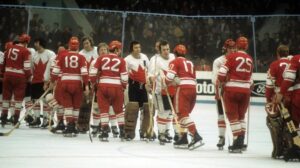
1972 Summit Series (NHL.com).

To this day, the emotions I felt back then as a nine-year-old hockey fan in Nova Scotia still resonate with me 50 years later.

Plenty of ink has been spilled and miles of videotape used to evoke how that series changed the game, how it made the NHL a better league by opening it up to the world, moving it toward today’s fast-paced, highly-skilled product played by its well-trained athletes.

Those changes are very apparent when comparing today’s game with the videos of the Summit Series. The play back then isn’t really all that great, the skills seem at times rudimentary, the pace sometimes plodding. We occasionally see some great passing, skating, scoring and saves.

For fans used to today’s style of play, who have no memory of the Summit Series, it can seem a rather boring affair with occasional bursts of excitement.

To those of us who lived through that series, however, that was hockey as played by the world’s best. It was what we were used to.

What makes the memories of that series so strong for me was the uniqueness of that series and of the time and circumstances under which it occurred.

As has been well-documented, this was the first time Canada’s top professionals were taking on the Soviets’ best. While Canadians laid claim to hockey as “our game,” we hadn’t won at the amateur level in international play for two decades by that point. The Soviets had dominated at the World Championships and the Olympics.

Canadian professionals were barred from participating in those tournaments. So we as a nation of hockey fans dismissed the Soviets’ accomplishments. Sure, they could beat our best amateurs, but they’d never faced our professionals.

We were so certain the NHL stars (who were all Canadian back then) would mop the floor with the Soviets that we were smug about our chances when this series was announced.

I knew about the series thanks to the sports section in our newspapers and the supper hour news. No 24-hour sports channels or internet coverage back then. Being a kid, I only knew a little about the geopolitics of the time. The Soviet Union were the bad guys and we Canadians were the good guys because they didn’t believe in freedom and we did, or at least that was the simplest narrative the adults in my life used to explain it to me.

Because of the Cold War and the so-called “Iron Curtain”, the Soviet players were a mystery to us. We certainly knew every member of Team Canada’s roster.

I was thrilled that my hero, Ken Dryden, was part of the team as well as his fellow Canadiens such as Yvan Cournoyer, Frank and Pete Mahovlich, Serge Savard and Guy Lapointe. I knew very well who Phil and Tony Esposito were, as well as Jean Ratelle and Rod Gilbert. Paul Henderson and Ron Ellis weren’t big stars but I knew them because they played for my second-favorite team at the time, the Toronto Maple Leafs.

I was disappointed that Bobby Orr’s knee would keep him from this tournament and that Bobby Hull wasn’t selected because he’d jumped to the rival World Hockey Association earlier that year. Nevertheless, we all knew that it wouldn’t matter because the Canadians had enough stars to win this series eight straight.

Of course, it didn’t happen like that at all. The Canadians had a 1-2-1 record after the first four games on home ice. I was as stunned and upset by the outcome as everyone else I knew. We couldn’t believe how our best players were being outclassed by the Soviets. It didn’t look good heading over to Moscow for the final four games.

And yet, somewhere along the way, we didn’t give up on “our boys”. Even when they fell 5-4 in Game 5 and were on the brink of losing the series, me and everyone I knew felt they could pull it off. Win Game 6, and they could tie the series in Game 7. Win that one, and it’s winner-take-all in Game 8.

Given my age, my parents only allowed me to watch the first two periods of the games in Canada. Games 5, 7 and 8 were on school days so I got to see the third period when I came home and then saw the first two periods during the rebroadcast that evening.

The critical Game 6 was on a Sunday and it was the only one I got to see aired in its entirety in real time because it was broadcast in the afternoon in Nova Scotia.

That game, the one broadcaster Foster Hewitt called “do or die” was the most nerve-wracking for me. Dryden, my hero, had not played well in his two games in Canada. I remember my dad complaining before the game that they should’ve started Tony Esposito. If they lost this one, the Soviets would take the series and the final two games would be meaningless.

My entire family watched that game that afternoon. That was unusual because my father was a die-hard baseball and CFL football fan who only had a mild interest in hockey. The only sport my mother enjoys is curling. My sister never had any interest in sports at all. And yet, there we were, riveted to the action beaming on our black and white TV from an arena with a strange name in Moscow.

This series by that point had become something more than hockey. It became more about our national identity. Canadians had a huge inferiority complex back then when it came to comparing ourselves to other countries, which is probably inevitable given our superpower neighbor to the south. However, the one thing we knew for certain was that we were the best at hockey.

And now, it appeared we were on the verge of losing that. Phil Esposito would later describe the series as more than a hockey tournament but something that evolved into a clash of cultures and nations. “It was our society against their society,” he said.

Those who have no memories of the Cold War cannot understand what that felt like. We had been told the Soviets were bent on conquering and enslaving the world with communism. They were the bad guys and our country, along with the other NATO nations, were the good guys.

To lose to the Soviets was unthinkable. It just couldn’t happen. And yet, it seemed like it was going to happen.

That’s what makes the Summit Series so memorable for those of us who lived through that time and watched that series. What was simply supposed to be a friendly tournament between the two best hockey-playing nations in the world became, for Canadians, part of the act of the Cold War playing out on the ice.

Games 6, 7 and 8 stand out for me and I think most Canadians who watched that series. Team Canada battled back to win all three by one-goal margins with Henderson scoring the winning goals in each contest. Dryden was rock-solid in Game 6 and prevailed in Game 8 despite giving up five goals in two periods.

Henderson’s winner in Game 8 remains the greatest goal I’ve ever seen. Not because it was done in a particularly skillful manner. Henderson picked up a rebound in front of the Russian net, took two whacks at it and managed to tuck it under Vladislav Tretiak for the winner.

It was the drama of the thing. The Canadians were down 5-3 entering the third period. Phil Esposito cut the Soviet lead to 5-4. Cournoyer tied it midway through the period.

I missed Esposito’s goal because that was a school day. Unlike other schools in Canada, our principal didn’t allow us to watch the game, though he was kind enough to update the score over the PA system as the game progressed.

It was 5-4 when I got home. My mother had the game on TV in the living room and was listening to it while she was working in the kitchen. She was skipping her soap operas (which she called “my stories”) to keep track of a hockey game.

I was able to see the drama of the remainder of that period. Henderson’s goal was so unexpected, the result of a broken play after he had fallen behind the net, with Hewitt’s practically screaming, “They Score! Hen-der-son! Has Scored For Canada!”

At that moment, I leaped from my chair and howled with delight. My mother ran in from the kitchen to see the replay. We both stood there in our living room watching the rest of the period play out.

The good guys had won. Canada was still the best.

What followed was a tremendous sense of joy, then relief, and underneath it all, the knowledge that hockey was never going to be the same after this.

Over the course of that series, I and millions of Canadian grew to admire and respect the Soviet stars.

Vladislav Tretiak was a terrific goaltender, especially in the first four games in Canada. Valeri Kharlamov was a dazzling, creative forward. Alexander Yakushev played a style similar to the high-scoring Phil Esposito. Boris Mikhailov was a physical, agitating forward who could match up well against any of his opponents.

After that, we knew our country could never take our supposed domination over the game of hockey for granted ever again.

There would be future international tournaments involving Canada’s best professionals with all the focus being on how they measured up against the Soviets. There would be dominating series wins on both sides as well as closely-fought ones. The 1987 Canada Cup best-of-three final was perhaps the best-played of the lot. Many of the best Soviet players from that series – Igor Larionov, Vyacheslav Fetisov, Sergei Makarov, Igor Kravchuk, Valeri Kamensky, Sergei Nemchinov – would go on to NHL careers.

Meanwhile, other countries were improving and challenging Canada and the Soviets. A trickle of European talent to the NHL in the 1970s became a flood in the 1990s with the end of the Cold War and the collapse of the Soviet Union. More American players, some inspired by “The Miracle on Ice” in 1980 or the 1996 World Cup of Hockey, joined their ranks.

Canadian players today still make up the majority in the NHL but only just. The top talent consists of players from a number of hockey-playing nations and the game is better because of it.

There will never be another international tournament like the ground-breaking 1972 Summit Series. It has shaped hockey over the past 50 years and its echoes are still being felt today. The experience of watching it unfold during that distant September and feeling all the emotions that came with it will stay with me for the rest of my life.